Can membrane technology be used to concentrate monomers generated in advanced plastics recycling and biotechnology processes?
This was the challenge presented to ESMIL by a customer seeking a solution capable of producing a monomer fraction suitable for commercial sale. Achieving this objective required increasing the concentration of sodium sulphate (Na₂SO₄) while reducing the dissolved salt content in the process stream.
To evaluate the suitability of membrane technology for this application, the ESMIL team carried out a pilot testing programme using nanofiltration (NF) and reverse osmosis (RO).
Nanofiltration and Reverse Osmosis for Monomer Concentration
The trial programme combined nanofiltration (NF) and reverse osmosis (RO) technologies. The process began with the concentration of monomer-containing streams and sodium sulphate (Na₂SO₄) using NF membranes. The NF permeate was then directed to the RO stage, where dissolved salts were further reduced.
Results achieved:
- Recoveries of up to 76% for NF and up to 84% for RO
- Conductivity increase during NF concentration from approximately 16,370–22,840 μS/cm to 50,960–59,310 μS/cm
- Reduction of RO permeate conductivity from approximately 350 μS/cm to around 70 μS/cm
- Effective concentration of sodium sulphate combined with significant dissolved salt reduction
The results confirmed that the combination of nanofiltration and reverse osmosis can effectively support monomer concentration while simultaneously reducing dissolved salt content.
4040 Membrane Pilot System
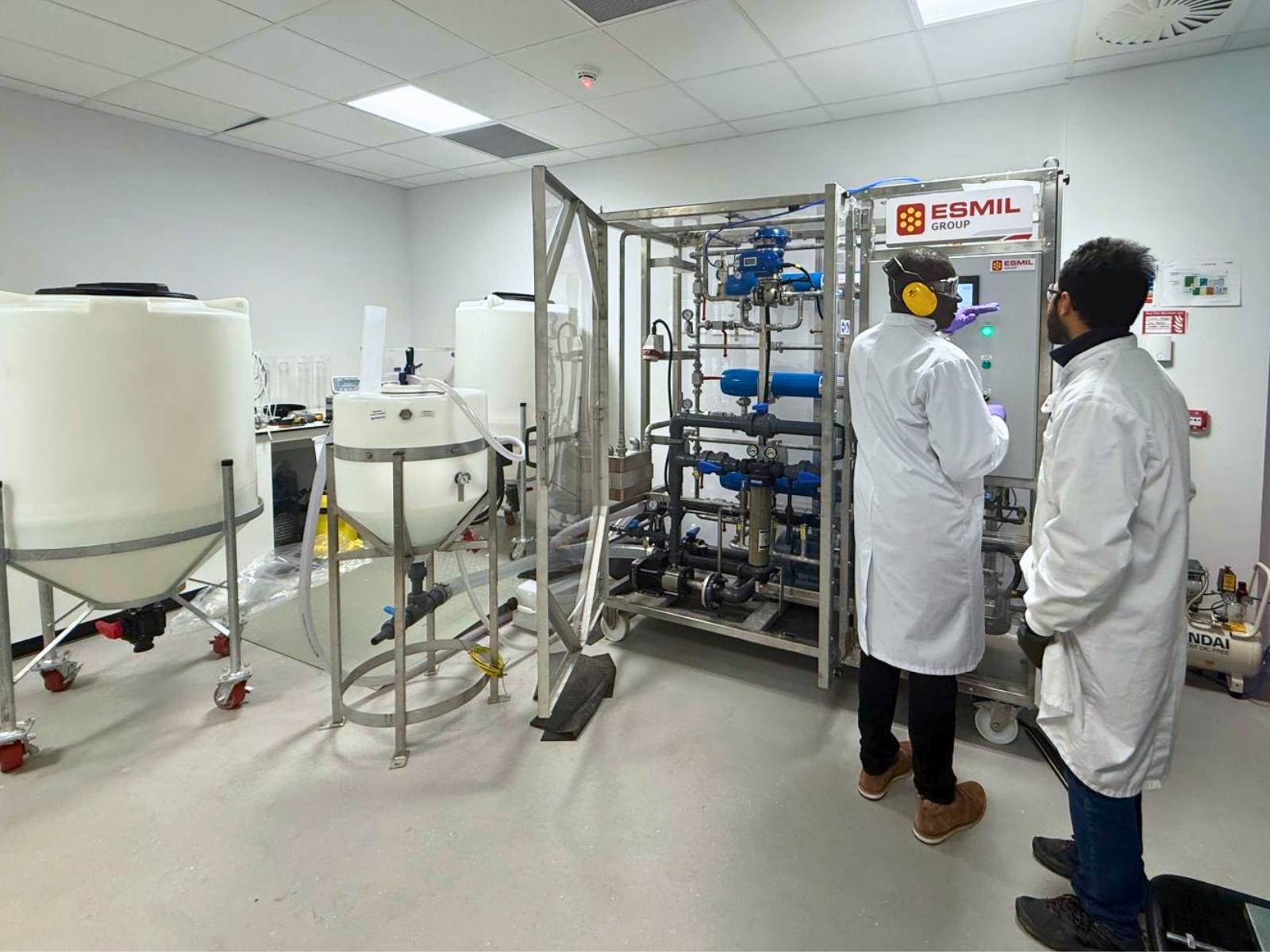
Following the successful pilot trials, the customer decided to proceed with a custom-designed pilot membrane system with a capacity of 1.8 m³/h based on 4040 membrane housings.
ESMIL was responsible for the complete design, manufacture, assembly and commissioning of the system. The pilot unit was built on a mobile skid platform capable of operating with different membrane technologies, including UF, NF and RO. This provided the flexibility required to evaluate multiple process configurations and optimise operating conditions as the project progressed.
After commissioning at the customer’s facility, further process optimisation work was carried out. The operational experience gained from the pilot unit confirmed the effectiveness of membrane technology for monomer concentration and paved the way for the next stage of project development.
8040 Industrial Membrane System
The pilot installation was not the final stage of the project. The results achieved during operation confirmed the potential of the technology and provided the foundation for further scale-up.
ESMIL is currently developing a containerised membrane system based on 8040 membrane modules, using operational data and experience gained from the pilot installation.
From Pilot Trials to Industrial Scale
This project demonstrates ESMIL’s process-driven approach to membrane system implementation. Every stage – from validating process assumptions and conducting pilot trials to designing a full-scale industrial installation—is based on data obtained under real operating conditions.
As a result, the solution can be continuously refined and optimised as the project progresses, while significantly reducing the risks typically associated with process scale-up.