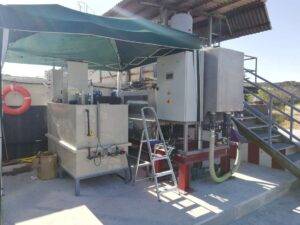
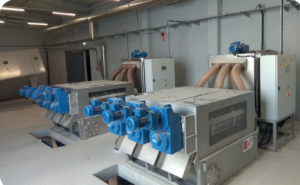
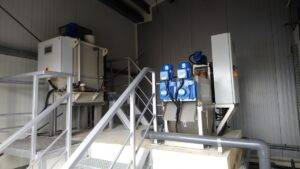
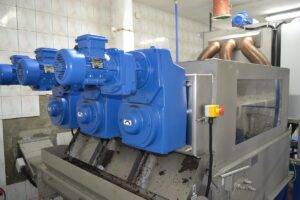
EQUIPMENT Multi-Disc Screw Press Dehydrator MDQ-352C(1) TYPE OF SLUDGE Tannery wastewater treatment process INITIAL SLUDGE AMOUNT 12 m³/day DS LOAD 1200 kg DS/day DS CONCENTRATION 10% START OF OPERATION July 2019
Issue
Sludge from the tannery production waste water treatment plant was filtered with use of a chamber filter press. A large amount of lime used along with complex operation and low automatization level have led to dissatisfaction and search for another dewatering technology. Additional aspect to consider was the future plans for the tannery plant capacity increasement, that the new dewatering solution should be able to deal with.
Solution
Aſter pilot tests, which were performed in January 2019, Multi-Disc Screw Press dewatering technology was selected for renovation. MDQ unit showed high productivity and dewatering efficiency at the same time with good quality of the filtrate.
A unique feature of MDQ is the ability to increase productivity by installation of additional screws. Taking into account future increasement in productivity, the MDQ-352C(1) with one screw and a free slot for the second one was offered to the Customer with perspective extension to MDQ 352. This has allowed the Customer to reduce initial CAPEX.
In July 2019 the new dewatering system based on Multi- Disc Screw Press Dehydrator MDQ-352C(1) has been commissioned under Esmil expert’s supervision.
Case Study: Delivery and Start-Up of the Sludge Dewatering Complex based on Multidisc Screw Dehydrators in Poultry Slaughterhouse (Kutno, Poland)
PURCHASER Nijhuis Industries Central Europe Sp. z o.o. OBJECT Meat factory, poultry slaughterhouse SEDIMENT TYPE Excessive activated sludge, initial flotation sludge DESIGNED CAPACITY 5000 m3/day
Objective
Sludges coming from the treatment of wastewater from meat processing services show specific parameters for this type of industry. They contain increased fat amounts and generally understood animal protein, which in turn requires use of dedicated technology for dewatering of this type of industrial sludge.
The sewage treatment plant is located around 20 km from Kutno, in the Łódź province. The initial entering sewage is a mixture of industrial wastewater from the production lines and biological wastewater which is formed as a result of the daily work of the plant.
The main goal of the investment was the construction of the wastewater treatment plant at the newly built production factory and as part of that the supply and commissioning of two independent and fully automated sludge dewatering complexes.
Plant Capacity
5 000 m3/day
Sewage Type
Industrial/poultry slaughterhouse
Sludge Type
Flotation + biological
Total Amount of Sludge
228 m3/day
Average DS in Sludge
5,6 %
Average Weight of Solid Sediments
12 845 kg DS/day
FLOTATION SLUDGE
Initial Amount
85 m3/day
DS in Initial Sludge
10 %
Weight of Solid Sediments
8 544 kg DS/day
BIOLOGICAL SLUDGE
Initial Amount
143 m3/Day
DS in Initial Sludge
3 %
Weight of Solid Sediments
4 300 kg DS/d
DS Content in Sludge Cake
22%-26% +/-1%
Work Progress
To determine the efficiency of sludge dewatering, first laboratory tests were performed. Because the plant in which this technology meant to be implemented was still under construction, the tests were carried out in another plant, which had an identical production line and purification technology to the built one. When selecting the device, the experience of Esmil Prodeko-Ełk was used as a supplier of comprehensive solutions based on modern technologies.
The analysis of advantages and disadvantages of the use of various sludge dewatering devices at a given facility has led to the selection of the multidisc screw dehydrators (MDQs), whose main advantages are:
simple operation,
low energy, flocculant, water consumption,
very low noise,
the ability to work in automatic mode
The scope of delivery included two independent drainage lines. Each of them consisted of a multidisc screw press, an automatic polymer preparation station, a sludge feed pump and a polymer dosing pump.
Multidisc screw dewatering units and the other supplied devices work efficiently and reliably. The operating parameters of the sludge treatment units in both lines enable them to obtain sludges with the level of DS up to 34%. Equipped with full automation, it allows the user to optimalise the dewatering process and meakes the sludge management much easier.
Case Study: Industrial Sludge Dewatering at the Beverage Factory (Sucheava, Romania)
TYPE OF INDUSTRY Food and beverage industry PLANT CAPACITIES 1,3 million litres per year START OF OPERATION October 2018
Issue
The Beverage Factory has been treating their wastewater using an external company. Due to high transportation costs, a decision was made to build their own wastewater treatment plant on-site. The full technology was developed for technological and domestic wastewater treatment to safely discharge treated water to the environment. The problem was only in utilization of generated sludge, as its transportation by an external company was of high cost. Hence, Esmil was invited to develop the technology and supply the equipment for sludge dewatering.
Solution
Aſter receiving the enquiry, Esmil professionals began calculations and selected the best dewatering equipment for the sludge regarding its fl owrate and composition. The flocculant solution preparation station was also adjusted to provide fully automatic operation of dewatering facility. Soon aſt er multidisc screw press MDQ-102C and solution preparation station SMART Mix 2100 was successfully installed and commissioned at the site. Multidisc screw dehydrator was selected considering its advantages before other equipment. With much more lower footprint compared to a decanter centrifuge and a belt fi lter press, it ensures silent and trouble-free operation with no need of periodical maintenance. Additionally, the power consumption is reduced significantly comparing to the centrifuges, and the water consumption – comparing to the belt-filter presses. What is more, even if to compare with other modern dewatering equipment such as screw press, the multidisc screw press still allows achieving of lower flocculant consumption with easier maintenance. Aſter commissioning, the complex operation was synchronized and adjusted to work automatically together with other technological equipment for wastewater treatment. Whenever DAF sludge is collected in the sludge tank, the facility starts the dewatering process that shows high effi ciency regarding to equipment capacity and a moisture content of the dewatered cake, which is then periodically taken and utilized by the external company at a greatly reduced volume achieving low operational costs.
CASE STUDY: Production and setting up of a municipal sludge dewatering facility (Biskupiec, Poland)
Aim of work:
The studied municipal wastewater treatment plant is located in Biskupiec, Warmian-Masurian voivodship, Poland. It serves Biskupiec city and Rukławki village. Inlet wastewater consists of household, industrial sewage from nearby meat plants and rainwater. The average capacity is 1 450 m3/d, with the maximum of 1 725 m3/d.
After mechanical and biological treatment, an excess sludge with humidity of approximately 99.7 – 99.8% is generated in amount of approximately 360 m3/d, which is then gravitationally thickened to a dry solids content of 1.0 – 2.0% in an amount of approximately 60 – 120 m3/d. Earlier, the sludge was dewatered on the belt filter press and then utilized partially for agriculture needs as well as distributed to the sludge plots.
The necessity of reconstruction was caused by poor dewatering process efficiency which affected in high humidity of dewatered cake (approx. 10 %). Additionally, existed belt filter press capacity of approx. 60 m3/d was insufficient to process the entire amount of sludge even beside the fact it was operating with high accident rate.
As the company with rich experience in municipal sludge dewatering technology, Esmil IG was able to offer an appropriate solution and accepted this project for work.
Progress of work:
To get acquainted with the case, laboratory and pilot studies were carried out. First of all, flocculation tests were conducted and the optimal process parameters were obtained. Further pilot scale tests allowed to find the optimal dewatering process parameters in real conditions. The results were analyzed and necessary calculations were done which gave Esmil constructors opportunity to fit and design the best appropriate dewatering technology.
After the old dewatering complex was removed, the new equipment were installed with respect to all client and labor protection requirements. Then it was commissioned and all technological parameters were adjusted to meet the best dewatering efficiency for this kind of sludge.
Parameter
Value
Average WWTP capacity
1450 m3/d
Sludge dewatering facility capacity
120-150 m3/d or 1,9 tDS/d (135 kgDS/h)
Average DS content in sludge
1,5 %
Average DS content in dewatered cake
15-17 %
TSS in filtrate
60-260 mg/l
Flocculant dosage
9,3 kg/tDS
Manual control time (for 8 h working shift)
20 min on adjustment + 30 min on overall maintenance (can be carried out during nonstop equipment operation)
Availability (as a metric of overall equipment efficiency)
90-97%
The reconstruction of the sludge dewatering facility at Municipal Wastewater Treatment Plant in Biskupiec allowed to increase its capacity from 60 to 120-150 m3/d.
Despite of extremely low dry solid content in initial sludge caused by its specific composition and poor thickening process efficiency, installed equipment managed to obtain dewatered cake of transportable consistence and allows ta save expenses on further transportation and utilization due to its quantity reduction. The new technology allows to obtain higher dry solids content in cake (up to 17 %) and cleaner filtrate (60-260 mgTSS/l) with fully automatic and reliable operation of Esmil equipment even in such complicated case, when average dry solids content in inlet sludge is only 1,5 %.
Moreover, implemented technology leads to additional operating costs decreasing due to water, electricity and reagent consumption reduction.
SIZE OF WWTP 700 m3/day (184 900 GPD) END USER Northern Hungary regional water and wastewater utility provider, ÉRV Zrt. CUSTOMER Northern Hungary regional water and wastewater utility provider, ÉRV Zrt. START OF OPERATION December, 2016
Issue
The client was not satisfied with the existing belt-filter press because of high repair and maintenance costs, therefore they decided to change it during the general reconstruction of WWTP. The client was looking for sludge dewatering solution with low power consumption as well as small footprint to be installed in place of the existing filter press.
Solution
After the detailed analysis and comparison with other manufacturers, the client chose our dehydrator. The client was impressed by reliability, low wash water consumption and negligible odour emissions due to the enclosed design of our dehydrators operating in Scécsény and Ózd WWTPs, Hungary. Based on the required dewatering capacity, one unit of MDQ-351 C was installed, while previously installed belt-filter press is stored as a metal scrap in the territory of WWTP. Esmil specialists actively assisted during all project steps – starting from the development of new sludge dewatering scheme, ending with the replacement of existing facilities with new equipment and pipework installation – making it virtually a turnkey project.
SIZE OF WWTP 2000 m3/day (528 300 GPD) END USER Northern Hungary regional water and wastewater utility provider, ÉRV Zrt. CUSTOMER INWATECH Kft. START OF OPERATION December, 2014
Issue
The client had frequent maintenance issues with their belt-filter press, therefore they decided to change it during the general reconstruction of WWTP. However, no belt-filter press manufacturer could guarantee more than 18 % DS content of sludge cake.
Solution
Esmil performed on-site pilot tests with a small MDQ model and achived 18.5-20 % cake DS content. The client was satisfied with the results and decided to purchase our equipment. Based on the required dewatering capacity, one unit of MDQ-353 C was installed. Previously installed belt-filter press is stored as a metal scrap in the territory of WWTP.
Results
Type of sludge
Waste activated sludge from SBR
Unit Sludge Supply
12-18 m3/h (53-80 GPM) 210-230 kg DS/h (463-507 lb DS/h)
Feed Sludge DS Concentration
1-2 %
Cake DS Concentration
18-22 %
Operation Time
10 h/d
Average Polymer Dose
4-6 g/kg DS (8-12 lb/ton DS)
Unit Daily Power Consumption
25 kW*h
End User’s Comment
Since the comissioning, the performance of Esmil multi-disc screw press dehydrator MDQ-353 C has been stable and with no issues. With an average feed DS content of 1 %, the cake DS content is 18-22 % while maintaining the required filtrate quality. Control cabinet is equipped with a touch screen which enables setting operational parameters both for the dehydrator and a sludge pump. Operation of the dehydrator is fully automatic, therefore it requires no attention of an operator. Besides beeing almost noiseless, the performance is also reliable and faultless. Over 3-year operation period, only wash water hoses have once been replaced.
Case Study: Industrial WWTP (Kerry Ingredients & Flavors, Savanah, GA, USA)
TYPE OF INDUSTRY Food and beverage industry START OF OPERATION February, 2017
Issue
In this plant sludge from DAF-unit and MBBR reactor was stored on-site in tanks and its utilization was outsourced to an external company. Due to expensiveness of such service, it was decided to build a local dewatering facility to reduce sludge volume and its disposal cost.
Solution
Esmil company offered a sludge dewatering solution based on one multi-disc screw press dehydrator MDQ-353 C. Other auxiliary equipment including a polymer solution preparation unit and pumps as well as piping was supplied by our local partners, assembled by the customer and commissioned by Esmil representatives to meet the highest dewatering process efficiency.
End User’s Comment
Since the comissioning, the performance of the dewatering equipment has been stable, highly efficient and with no issues. High dewatering efficiency resulted in significant sludge volume reduction, so the construction of the local dewatering facility has paid off very quickly.
SIZE OF WWTP 5400 m3/day (1 427 000 GPD) END USER Northern Hungary regional water and wastewater utility provider, ÉRV Zrt. CUSTOMER VEOLIA Water Solutions & Technologies Magyarország Zrt. START OF OPERATION September, 2015
Issue
During the preparation of Ózd WWTP construction project, engineering department of one of the leading companies in the field of wastewater treatment was looking for an effective sludge dewatering solution with low power consumption as well as small footprint.
Solution
After the detailed analysis and comparison with other manufacturers, the client chose two MDQ-352 C units. During the design stage, Esmil specialists actively assisted in the development of sludge dewatering scheme.
Results
Type of sludge
Thickened waste activated sludge
Unit Sludge Supply
7-7.5 m3/h (31-35 GPM) 140-150 kg DS/h (309-331 lb DS/h)
Case Study: Municipal WWTP (Medgyesegyháza, Hungary)
SIZE OF WWTP 300 m3/day (79 250 GPD) END USER Public utility provider, Gyulai Közüzemi Nonprofit Kft. CUSTOMER Pure-Aqua Kft. START OF OPERATION October, 2015
Issue
The client was not satisfied with the existing belt-filter press because of high repair and maintenance costs, therefore they decided to change it during the general reconstruction of WWTP. The client was looking for sludge dewatering solution with low power consumption as well as small footprint to be installed in place of the existing filter press.
Solution
After the detailed analysis and comparison with other manufacturers, the client chose our dehydrator MDQ-201. During the design stage, Esmil specialists actively assisted in the development of sludge dewatering scheme.
Results
Type of sludge
Mixture of primary sludge and waste activated sludge
Unit Sludge Supply
0.5-1.3 m3/h (2.2-5.7 GPM) 16-18 kg DS/h (35-40 lb DS/h)
SIZE OF WWTP 380 m3/day (100 400 GPD) END USER Transdanubian regional water and wastewater utility provider, DRV Zrt. CUSTOMER KEVITERV PLUSZ Komplex Vaillakozasi Kft. START OF OPERATION September, 2015
Issue
Prior to the construction of new wastewater treatment facilities in Karád, the client was looking for an effective sludge dewatering solution with low power consumption as well as small footprint.
Solution
After the detailed analysis and comparison with other manufacturers, the client chose our dehydrator MDQ-201. During the design stage, Esmil specialists actively assisted in the development of sludge dewatering scheme.
Results
Type of sludge
Thickened mixture of primary sludge and waste activated sludge
Unit Sludge Supply
0.5-1.3 m3/h (2.2-5.7 GPM) 18-20 kg DS/h (40-44 lb DS/h)
To provide the best experiences, we use technologies like cookies to store and/or access device information. Consenting to these technologies will allow us to process data such as browsing behavior or unique IDs on this site. Not consenting or withdrawing consent, may adversely affect certain features and functions.
Functional Always active
The technical storage or access is strictly necessary for the legitimate purpose of enabling the use of a specific service explicitly requested by the subscriber or user, or for the sole purpose of carrying out the transmission of a communication over an electronic communications network.
Preferences
The technical storage or access is necessary for the legitimate purpose of storing preferences that are not requested by the subscriber or user.
Statistics
The technical storage or access that is used exclusively for statistical purposes.The technical storage or access that is used exclusively for anonymous statistical purposes. Without a subpoena, voluntary compliance on the part of your Internet Service Provider, or additional records from a third party, information stored or retrieved for this purpose alone cannot usually be used to identify you.
Marketing
The technical storage or access is required to create user profiles to send advertising, or to track the user on a website or across several websites for similar marketing purposes.
Esmil Group stands as a premier global manufacturer, crafting cutting-edge equipment for wastewater treatment and sludge dewatering. Additionally, we specialize in delivering advanced membrane systems tailored to various industries.