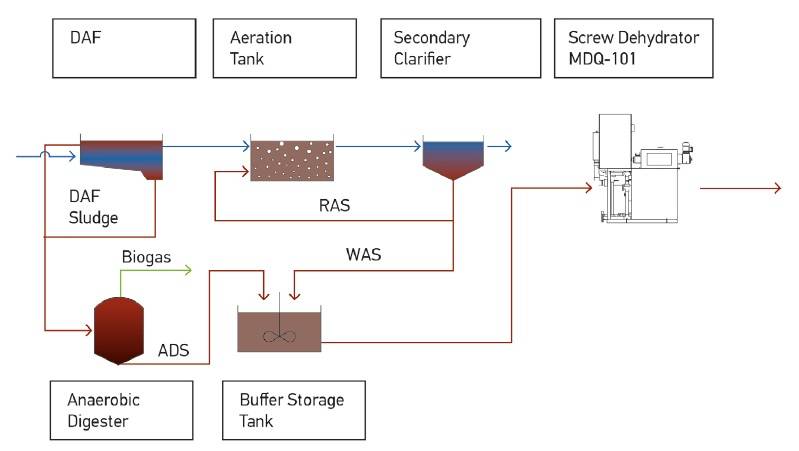
TYPE OF INDUSTRY Poultry slaughterhouse and meat processing plant MODEL OF DEHYDRATOR MDQ-101 DATE OF PILOT TESTS August, 2016
Issue
The client could not achieve high DS content of sludge cake with the existing centrifuges (barely 13.5 % was achieved with the polymer dose of nearly 19 g/kg DS (38 lb/tonDS). Due to high operation and sludge disposal costs, the client wanted to find a more effective solution and for that was looking for other types of dewatering equipment.
Solution
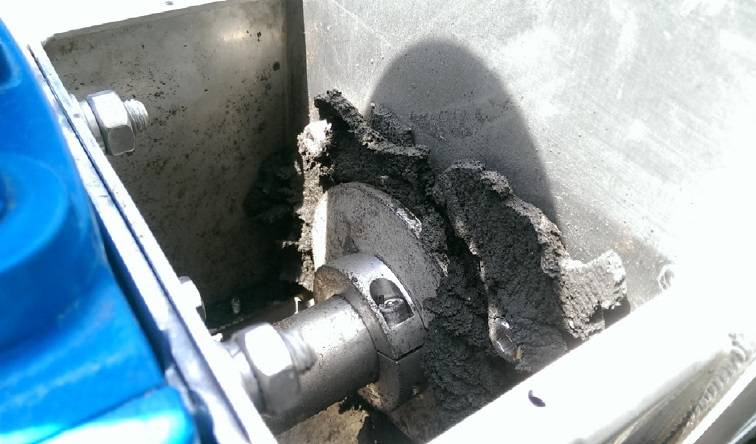
Esmil brought the MDQ-101 dehydrator with ancillary equipment to the WWTP to perform on-site pilot tests. During the tests, optimum polymer type and operating parameters were determined which resulted in 30 % higher cake DS concentration and consequent reduction of sludge disposal costs as well as reduction of polymer consumption by more than 50 % compared with the existing centrifuges. The client also noted the very low energy consumption of the MDQ dehydrator and low rotation speed of its screw which resulted in slower wear and tear processes compared with the centrifuges.
Results
Type of sludge
Mixture of waste activated sludge and anaerobically digested DAFsludge (nearly 50:50 %)
Unit Sludge Supply
0.10–0.22 m3/h (0.44–0.97 GPM) 3–6 kg DS/h (6.6–13.2 lb DS/h)
SIZE OF WWTP 22 000 m3/d (5 812 000 GPD) START OF OPERATION November, 2013
Issue
Soon after the reconstruction of WWTP and launching a new biological reactor with EPDM membrane disc diffusers in 2009, the aeration system appeared to be highly uneconomical. In order to keep the constant dissolved oxygen DO concentration of 1.5-2.0 mg O2/l in the reactor, three blowers with capacity of 4500 m3/h each had to work continuously almost all the time.
Solution
Because of its low economic efficiency and tearing of some diffusers noticed at the beginning of 2013, it was decided to replace the existing aeration system. Esmil company installed 600 m (1970 ft) of highly efficient PE tube air diffusers with high mechanical strength and longevity. Previously installed air diffusers were replaced gradually section by section.
Results
Bioreactor Size
3 sections, 6000 m3 (1,6 MG) each with an operating height approx. 6 m
Type of biological treatment process
Aerobic suspended growth
DO concentration
2.0 mg O2/l
Supply air flow rate
4500-9000 m3/h (2650-5300 cfm)
End User’s Comment
After we launched the first section of the reactor with Esmil tube air diffusers, the quantity of consumed air as well as the energy was significantly reduced. Wastewater saturation with oxygen became more stable and uniform throughout the whole basin. After the old aeration system in all reactor sections was replaced with Esmil air diffusers, the quantity of consumed air was reduced up to 3 times. From November 2013 so far there has been no diffuser breaking detected or any other problems occurred.
Case Study: Modernization of the Primary and Secondary Clarifiers (Slupsk, Poland)
PROJECT Modernization of the primary and secondary clarifi ers CUSTOMER Wodociągi Słupsk Sp. z o.o. OBJECT WWTP Slupsk, Poland COMMISSIONING March, 2017
Introduction
The wastewater treatment plant is located in the northern part of the Słupsk city, on the right bank of the Słupia River. It is a mechanical-biological treatment plant, adapted for deep removal of biogenic compounds in a threephase, modified Bardenpho process, supplemented with a predenitrification chamber. The capability of the treatment plant corresponds to 200,000 population equivalent, and the average daily fl ow of about 19 647 m3/day.
In November, Esmil Prodeko-Ełk Sp. z o.o. has been selected as a General Contractor and signed an agreement with Słupsk Waterworks for the task: “Delivery of a dewatering centrifuge and scrapers to the municipal sewage treatment plant in Słupsk at ul. Sportowa 73 – task no. 2 – Delivery of the scrapers along with the performance of necessary construction, assembly and installation works.
As part of the contract, the following facilities were modernized:
Preliminary settling tanks with a diameter of D = 34m – 2 sets
Secondary clarifiers with a diameter of D = 40m – 2 sets
The modernization included dismantling of the old scrapers, delivery, assembly and kick-start of the new ones and also commissioning and warranty tests.
Initial Stage
The preliminary settling tanks were built in the first stage of construction of the wastewater treatment plant in 1986 and equipped with radial scrapers according to the solutions used in the 1970s. As a result of the modernization of the sewage treatment plant in 2006-2009, one of the primary settling tanks has been adapted to the retention and overflow function. The technical condition of the scrapers at the initial stage of the project was very poor and qualified them for replacement. In case of secondary clarifiers, the situation was similar, with the diff erence that the facilities were built in 1978 and modernized in 2001.
Project Goals
The main goal of the signed modernization project was to improve the efficiency of sludge removal from both primary and secondary clarifiers.
In order to solve the problems and ensure stable and proper conducting of the technological process in both the sewage and sludge part, it was necessary to replace the scrapers in two primary settling tanks with models ensuring greater efficiency and reliability. Ultimately, this meant to improve the balance of the initial and excessive sludge, and thus increase the biogas production and reduce the operating costs of the treatment plant. Also the scrapers had to be replaced on the two existing secondary clarifiers. Part of the modernization was to supply the equipment with so-called side scraper, similar to ones mounted on two clarifiers that were built in 2008-2009.
Project Implementation
The modernization project of the preliminary and secondary clarifiers has been carried out between 15th of October 2018 and 28th of March 2019 and consisted of:
disassembly of the old (existing) scrapers and placing them in the containers provided by the INVESTOR,
preparation and delivery of the new scrapers made entirely from AISI 304 (1.4301) steel, sized to existing facilities,
installation of the new scrapers in an alternating system, i.e. first preliminary, then secondary, then again preliminary and finally secondary clarifier
technological start-up of each of the settlers and putting them into operation.
Results and Conclusions
As a result of modernization of the preliminary settling tanks, by installing new scrapers, problems related to ensuring stable and correct conducting of the technological process in both the sewage and sludge part were solved. The new scrapers are characterized by greater efficiency and operational reliability, which significantly contributed to the improvement of the initial and excessive sludge balance, and thus to increased biogas production and reduction of the operating costs of the treatment plant.
However, as a result of replacing scrapers in the existing secondary clarifiers with the devices equipped with so-called side-scraper, the removal of activated sludge excess to the surface of the settling tank in relation to normal operating parameters has been eliminated. This, in turn, resulted in a decrease of the total suspended solids discharged with sewage,and with it the load of carbon, nitrogen and phosphorus in the treated sewage to the Słupia river.
By replacing scrapers with ones equipped with the catching scrapers, the duration of active sludge retention within the secondary clarifiers has been shortened, which has prevented the formation of anaerobic conditions and secondary biological dephosphorization, and as a consequence – the process of secondary release of the orthophosphates into the wastewater from the activated sludge accumulated at the bottom.
Case Study: Modernization of Sewage Treatment Plant (Myszkow, Poland)
PROJECT Modernization of the secondary clarifier CUSTOMER Schumacher Packaging Zakład Grudziądz Sp. z o.o. OBJECT Local WWTP, The Paper Factory in Myszków COMMISSIONING January, 2019
Introduction
The Paper Factory in Myszków was founded in early 1894 year, where at the time it was the largest paper production plant in Poland. In 2016, the factory became part of the Schumacher Packaging group. To ensure high quality standards and increased paper production plant modernization project has began. One of the main tasks of the project was to increase the throughput of the existing sewage treatment plant located on the production plant premises. In July 2018, PRODEKO-EŁK Sp.zo.o. (Esmil Industrial Group) was chosen as the main contractor for the modernization of the secondary clarifi er at the Sewage Treatment Plant of the paper factory in Myszków.
Modernization Purpose
The aim of the project was to replace the existing radial sludge scraper and the drainage system of the secondary clarifier with a diameter of 39.4 m. The mounted device is designed to ensure high effi ciency of sludge and floating parts removal.
Initial Stage
The modernized secondary clarifi er was not exploited for many years. It was equipped with a radial sludge scraper made from black steel and also concrete drainage troughs. The plan was to remove the scraper with troughs, repair of concrete elements of the clarifier, assembly of a scraper along with the trough system made from stainless steel.
Project Implementation
As part of the contract, a ZGRwt-39.4 type of a radial scraper has been delivered with a drainage trough system. The scope of work included preparation of the documentation to fabricate the parts adapted to the size of the settling tank as well as assembly and technological commissioning of the supplied devices.
Results and Conclusions
The use of modern technological solutions in the sludge scraper designing ensured high work efficiency, energy efficiency and reliability. As a result of the installation of the new scraper hasthe following goals have been achieved:
ensuring effective removal of the sludge and floating parts;
Reference of Astrvodokanal MUE about the Operation of the Esmil Slide Gates
From reference Astrvodokanal MUE:
The slide gate of stainless steel with the dimensions of 2330*2200 mm was installed on the distribution bowl of primary clarifiers of the Northern sewage treatment facilities in May 2009. For the time of operation, the personnel has noticed such features as ease of installation, ease of the manual operation, resistance of the material of the gate to corrosion, compaction equipment ensuring the leak-free shutoff of the channel, ease of maintenance and operational reliability.
CASE STUDY: Catenary Screen (Olecko, Poland)
Installation of a Catenary Screen and a Screenings’ Wash Press at the Sewage Pumping Station (Olecko, Poland)
PROJECT Modernization of the sewage pumping station in Olecko INVESTOR Przedsiębiorstwo Wodociągów i Kanalizacji Sp. z o. o. in Olecko OBJECT Sewage pumping station at Batory street STARTING December 2018 – June 2019
Plans and Modernization Goals
According to the modernization plan of the pumping station building located at Batory street in Olecko delivery of equipment was divided into two stages:
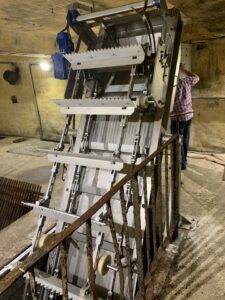
December 2018 – delivery and installation of the mechanical catenary screen bar type RKC 0827 with 6 mm clearance.
June 2019 – delivery and installation of SCP 2020 type screenings wash press with Q = 2 m3/h capacity along with the necessary supporting structure.
The purpose of the modernization of the main pumping station was to increase the efficiency of removing solid parts from inflowing sewage, as well as to reduce the amount of generated screenings and their hydration.
State from before the Modernization
City’s sewage is directed to the pumping station’s main collecting chamber, and then goes to the grate, which is mounted in a channel with dimensions Bk = 950 mm, Hk = 2000 mm. Before the project, problems related to the presence of the wet wipes occurred, which caused diffi culties in normal gate operation and its blocking. Screenings collected on the grating were transported to the screw conveyor, through which they were transported to the collecting container. The shiſt operator then had to transport the container outside of the building and load it onto the removal vehicle. The main problems associated with the operation of the old devices were:
large costs related to the handling and cleaning of the grate from wet wipes and the removal of screenings with a high water content;
problems related with stopping the grate too oſten;
pump failure and operational problems at further stages of purifi cation that were caused by insufficient efficiency of solid impurities removal.
Results
Aſter analyzing the situation at the pumping station, specialists from Esmil Industrial Group have decided to install a grid prototype to check the efficiency increment comparing to the old device. The RKC 0827 catenary screen bar has been installed at the pumping station, the very first to be produced at our plant. Aſter three months of operation, the management of the plant has decided to buy back the installed device and order SCP 2020 screenings wash press.
As a result of installation of the new equipment, the following results were obtained:
Thanks to the use of an innovative chain mechanism that allows efficient collection and extract of a various types of wastes and wet tissues from sewage, the number of failures associated with grid jams has been reduced;
The number of removed screenings has doubled due to the use of a grid with a clearance of s = 6 mm within the strainer;
The weight of removed screenings has been reduced over three times, thanks to the pressing and rinsing them on the SCP wash press;
The time necessary to operate the equipment has decreased by over 95% due to the use of a full automatic mechanical treatment line.
In addition, the following upsides related to equipment replacement should be noted:
A significant decrease in the number of failures and repairs at further stages of wastewater and sludge treatment;
Total elimination of the need to work in a manual mode when removing screenings from grates.
Conclusions
The modernization of the mechanical sewage treatment system at the pumping station allowed the organization of an effective treatment system for large and medium solid wastes, using a special construction of the grid chain. Screenings, removed from the sewage, are washed to reduce their organic content and pressed on a wash press to reduce their volume and weight.
The installed mechanical cleaning line works fully automatically and does not require constant presence of a personnel. The work of the mechanical wastewater treatment complex has fully met the requirements and ensured stable and trouble-free operation at subsequent stages of treatment.
CASE STUDY: Mechanical treatment (Augustow, Poland)
Project brief
PROJECT – Modernization of the mechanical wastewater treatment facility
CLIENT – Wodociągi i Kanalizacje Miejskie Spółka z o. o. w Augustowie
OBJECT – Augustów WWTP LOCATION Augustów, Poland
COMMISSIONING – January 2017.
The Municipal Wastewater Treatment Plant is situated in the southern part of Augustów. Its capacity is 10 000 m3/d.
In 2016 Esmil Company was chosen to implement investment project for the modernization of the main sewage pumping station which located at the Augustów WWTP. Within the project, the following equipment for mechanical wastewater treatment facility was produced, installed and commissioned:
Rake bar screen RKE;
Screw compacting press SCP;
Slide gates of ZSg type;
Facility control system.
The aim of the pumping station modernization was to increase the efficiency of mechanical impurities removal and waste thickening with full automation of the process.
Initial state:
In accordance with initial project, wastewater was fed via two collectors into the pumping station, where it was mechanically treated on the screens with 25 mm mesh.
Screen cloth cleaning was carried out manually by the personnel as it became clogged. The removed waste was fed into the container for its further lifting by means of lifting device to a zero mark (ground surface) into a receiving tank.
The main problems which were occurring during operation of the old equipment are following:
The need of constant monitoring of the screen cloth to prevent pump station flooding and emergencies;
High cost of the screen cloth cleaning and further waste transportation into receiving tank;
Pumping equipment and further stages emergencies occurring due to insufficient removal of mechanical impurities.
Project implementation:
One of the key complication during the project implementation was installation of equipment in existed pumping station among which:
The building was not designed for installation of equipment with length of more than 2,5 m, thus there was a requirement to produce rake screen with 6 m length from separate parts with length of 2 m max. Every part was mounted on supporting structure which were brought together inside the pumping station for further parts assembling inside the building.
Results:
The modernization project allowed to achieve the following results:
After the new rake screens installation with 5 mm mesh, the amount of removed waste was increased by 2 times.
Due to the partial waste dewatering with screw compacting press SCP, its overall mass has decreased more than 3 times.
The necessary time for equipment maintenance reduced more than by 95 % due to its replacement on the new one which operates in fully automatic mode.
It should be also noted the additional advantages achieved by mechanical wastewater treatment equipment replacement:
Considerable decreasing of emergencies and scheduled repairs on the next stages of wastewater treatment technological process.
Full elimination of the need for manual labor which were necessary for waste removal earlier. It has significantly improved not only the sanitary condition at the pumping station, but also the labor conditions of the personnel.
The quantity and mass data of the waste removal from the screens in period from 2015 to 2017 is given below in figures. The pumping station modernization was carried out in the fourth quarter of the 2016 and in January 2017, the new mechanical treatment facility was launched; the data from that year indicates significant treatment parameters improvement.
Reliable screen and screw press design provide the treatment facility with a possibility of round-the-clock and trouble-free operation of equipment in automatic mode. Daily maintenance and inspection requires no more than 15 min.
The amount and mass of wastes removed from the screen in the period from 2015 to 2017
Time for equipment maintenance in minutes per day
Conclusions:
The mechanical treatment facility modernization at the sewage pumping station allowed to organize efficient wastewater treatment from large and average impurities. Removed wastes are rinsed for organic part reduction and are thickened on the screw press for its volume and weigh reduction. Installed mechanical treatment facilities operate in fully automatic mode and do not require constant personnel presence. The mechanical treatment process improvement allowed to solve all of the set challenges and assured stable and uninterrupted wastewater treatment process operation.
MODEL OF DEHYDRATOR MDQ-101 DATE OF PILOT TESTS June, 2017
Issue
R&W Filtertechnik GmbH (Wuppertal, Germany) as a company that specializes in the field of filtering and dewatering of sludges and slurries was interested in onsite testing of a multi-disc screw dehydrator to verify its dewatering efficiency and operation parameters at the real facility as this kind of equipment is not widespread in Germany.
Solution
Esmil company together with R&W Filtertechnik GmbH performed on-site pilot tests of multi-disc screw dehydrator MDQ-101 in municipal WWTP in Radevormwald. The object of the study was the mixture of primary and excess activated sludge after anaerobic digestion and thickening. Initially, selection of optimum polymer type and dose was carried out and then optimal operating parameters of dewatering process were adjusted. The unit showed high process efficiency with high automation level along with its simplicity and was jointly recommended for the sludge treatment. At the same time, dewatering process based on multi-disc screw technology allowed to reduce electricity, polymer and water consumption compared with the existing chamber membrane filter presses assuring all requirements for further cake transportation and disposal.
Results
Type of sludge
Thickened and anaerobically digested mixture of primary and waste activated sludge
Unit Sludge Supply
0.09–0.26 m3/h (0.40–1.15 GPM) 2.4–6.8 kg DS/h (5.3–15.0 lb DS/h)
Reference of Wastewater Treatment Plant, Mezdra, Bulgaria
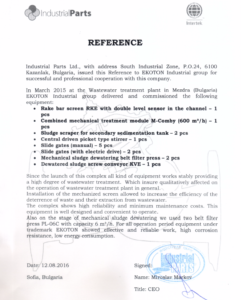
Industrial Parts Ltd., with address South Industrial Zone, P.O. 24, 6100, Kazanlak, Bulgaria, issued this Reference to Esmil Industrial Group for successful and professional cooperation with this company.
In March 2015 at the Wastewater treatment plant in Mezdra (Bulgaria) Esmil Industrial Group delivered and commissioned the following equipment:
Rake type bar screen RKE with double level sensor in the channel – 1 pcs
Mechanical sludge dewatering belt filter-press – 2 pcs
Dewatering sludge screw conveyer KVE – 1 pcs
Since the launch of this complex all kind of equipment works stably providing a high degree of wastewater treatment. With insure qualitatively affected on the operation of wastewater treatment plant in general.
Installation of the mechanized screen allowed to increase the efficiency of the deterrence of waste and their extraction from wastewater.
The complex shows high reliability and minimum maintenance costs.
This equipment is well designed and convenient to operate. Also on the stage of mechanical sludge dewatering we used two belt filter press PL-06C with capacity 6 m3/h. For all operation period equipment under trademark Esmil showed effective and reliable work, high corrosion resistance, low energy consumption.
Reference of Wabra Contractor, Zahran, Kingdom of Saudi Arabia
By here with we WABRA CONTRACTOR EST note that during the cooperation with the company Esmil it has acquired a reputation as the organization of highly professional specialists, which knows subtleties of the operation of wastewater treatment facilities and develops technologies of the highest world level. We, as main contractor, are glad to work with products that are manufactured at this enterprise.
In July 2016, 2 ZSP sludge scrapers with the diameter of 10+8 m were delivered, installed and put into operation in wastewater treatment plant 1500 m3/day for Air Forces Defense in Zahran, Kingdom of Saudi Arabia.
All installed equipment has been operating stably and smoothly from 2016. One of the main advantages of this type of equipment is the serviceability and reliability, Sludge scrapers are structurally designed for a long-term trouble-free operation. No wear of moving parts are observed.
The suggested design is proved to be stable, rigid and reliable in operation. Bridge on the sludge scrapers has central drive and mounted on two independent supports that are placed out of the clarifiers. Such construction allows not carrying and weight on GLS tank where scrapers must operate.
The cleaners of walls and edges of sludge scrapers are well designed, convenient in adjustment and don’t cause dissatisfaction. All the electric part of the drive runs smoothly in various temperature conditions.
WABRA CONTRACTOR EST thanks the team of Esmil for the high quality equipment and careful attention to the needs and requirements of our enterprise during the production, delivery and adjustment of sludge scrapers.
Manage Consent
To provide the best experiences, we use technologies like cookies to store and/or access device information. Consenting to these technologies will allow us to process data such as browsing behavior or unique IDs on this site. Not consenting or withdrawing consent, may adversely affect certain features and functions.
Functional Always active
The technical storage or access is strictly necessary for the legitimate purpose of enabling the use of a specific service explicitly requested by the subscriber or user, or for the sole purpose of carrying out the transmission of a communication over an electronic communications network.
Preferences
The technical storage or access is necessary for the legitimate purpose of storing preferences that are not requested by the subscriber or user.
Statistics
The technical storage or access that is used exclusively for statistical purposes.The technical storage or access that is used exclusively for anonymous statistical purposes. Without a subpoena, voluntary compliance on the part of your Internet Service Provider, or additional records from a third party, information stored or retrieved for this purpose alone cannot usually be used to identify you.
Marketing
The technical storage or access is required to create user profiles to send advertising, or to track the user on a website or across several websites for similar marketing purposes.
Esmil Group stands as a premier global manufacturer, crafting cutting-edge equipment for wastewater treatment and sludge dewatering. Additionally, we specialize in delivering advanced membrane systems tailored to various industries.